DISCLAIMER
Wednesday, June 2, 2010
Mathematics Marathon in Keetmanshoop

Saturday, April 17, 2010
Basic Education Teacher Diploma (BETD) INSET


Ever since Namibia's independence in 1990, education reform has been a top priority. Education spending consistently represents the largest percentage of the budget; yet, many obstacles to quality education remain. The reform process is consciously a gradual one. Teacher education and equitable distribution of qualified teachers are two areas that constantly receive attention. The presence and expansion of the role of WorldTeach volunteers in Namibia speak to these facts. WorldTeach volunteers are typically placed in areas, mainly rural areas, where there is a severe shortage of willing and qualified teachers for the number of learners needing to be served. Also, whereas WorldTeach began as providers of English language teachers, WorldTeach Volunteers can now be found teaching across the broad curriculum, and in special placements such as mine.Monday, April 5, 2010
Centre Captains Save Opening Day


Aware of the chaos-potential, I came to my senses and ran to a local senior high school on the morning of the Centre’s opening day, and gave an inspiring and captivating “value of community service” speech to grade 12 leaders. Five responsible young boys rose to the challenge (took the bait, hah!). These boys were Centre-saving and also morale-saving, I can admit.
I had to rush an orientation with the Captains and at different times throughout the first afternoon, I needed to corral them all outside to check-in and reinforce an expectation or rule (like learner-confidentiality) that I missed during the rushed presentation. Overall, though, I was pleased with the adeptness, sensitivity, and computer savvy of my young leaders. At the end of the day, they were also “complaining” about their hurting feet, from standing and moving around the classroom all afternoon; ‘twas wonderful.
The Centre Captains helped manage outside traffic; they helped orient new computer users to keyboarding and mouse basics; they helped users log-in and log-out of the educational learning software; they answered basic mathematics questions raised by young users; they guided learners on how to navigate through lessons; they alerted me to technical problems they couldn’t (and I didn’t want them to) address/fix; they kept me aware of time (there are three groups of full-time users registered for each day); and they helped me with some decorating of the Centre’s walls and doors!
During a recent business trip to meet with the learning software providers in South Africa, I collected t-shirts, which I will present to the volunteer Centre Captains. I will also create official applications and a formal description of their tasks/duties for Centre files and for their central reference. At the end of the term, I will present them with certificates of service. I will also leave the recommendation, for whomever is tasked to manage the Centre, to keep a record of their hours and author a letter summarizing their hours and service at the end of the next term. These boys are all college-bound; this community service may have a place in their admissions and scholarship/bursary applications. (I'm pictured with my top captain, Nahvad, who wants to become a mathematics teacher).
ABOUT THE REGISTERED USERS – Keetmanshoop Computer-Based Learning Centre
For the remainder of the 1st term and all of the 2nd term, there are now 150 registered learners, from nine(9) schools throughout the community. Learners were selected at the school-level, based on varying criteria established by each school. Each selected learner, along with a parent/guardian and a teacher, signed a commitment form and received an official registration letter/card, which the learner must bring to each of his/her assigned sessions (2 hours/week). The learners are in grades 5-12, and range in age from 10-22 years. The 22 year-old, is in grade 9! Actually, many learners registered to use the Centre are above the average age of learners in their grade, based on being held back or starting school very late; so, I'm happy that they may benefit from the additional instructional support. (I’ll write a post on social promotion or transfer policies later). I plan to have counseling sessions with all learners before I leave, to get more about their story, and to help them establish goals for their time in the Centre. I expect that the counseling sessions will present a few challenges, based on time, yes, but mainly based on language barriers. We’ll see. The main academic focus of the Centre is mathematics. PLATO is the name of the educational learning software used in the Centre.
Friday, March 26, 2010
Meeting Namibia's Premier - The Right Honourable Nahas Angula
Nahas Angula is one of the first names I learned when researching the foreign land of Namibia where I’d be living, partnering, and working for at least one year. Angula’s name popped up in my Google searches, and stood out because he is a fellow alumnus of Teachers College, Columbia University, having earned his M.A. and M.Ed there in 1979. He is the current Prime Minister and was the first Minister of Education of the newly independent Republic of Namibia. From the time of my arrival in the country, I’d been dropping little hints about wanting to meet him. I mentioned it to various government and education ministry officials, with whom I work and with whom I know he works, but no one really paid attention to my hints and no action resulted. Then, after receiving my admission offer to an EdD program at Teachers College and learning that he is the keynote speaker at a Teachers College Distinguished Alumni event next month, I decided to just go out on a limb and try to reach him directly. It would be good, I thought, to introduce myself and get his support for and guidance on future fieldwork I may wish to conduct in Namibia.
The Prime Minister of Namibia is appointed by the President in terms of the provisions of Article 32 of the Constitution. Further, Article 36 of the Constitution stipulates that "The Prime Minister shall be the leader of Government business in Parliament, shall co-ordinate the work of the Cabinet and shall advise and assist the President in the execution of the functions of Government" and Article 34 stipulates that where it is regarded as necessary or expedient that a person deputize for the President because of a temporary absence from the country, the President appoints the Prime Minister to deputize for him.
In terms of the provisions of the Public Service Act of 1995, the Prime Minister is also responsible for the overall management of the public service.
By virtue of his responsibilities of advising and assisting the President, as the leader of Government business in Parliament, as the co-coordinator of the work of the Cabinet, and as the political authority responsible for the public service, the Prime Minister's task involves co-coordinating the work of the government at inter-ministerial and inter-governmental levels and for projecting the good image of the government.
Independence 2010 - Thank Moses!


- This year (2010) marks the 20th Anniversary of Namibia’s Independence, “0”s and “5”s usually prompt more attention
- This year, I celebrated in the capital city, rather than in the coastal retreat of Swakopmund
- I participated in the nationally-planned central activities, which had the benefit of greater financial investment and marketing.
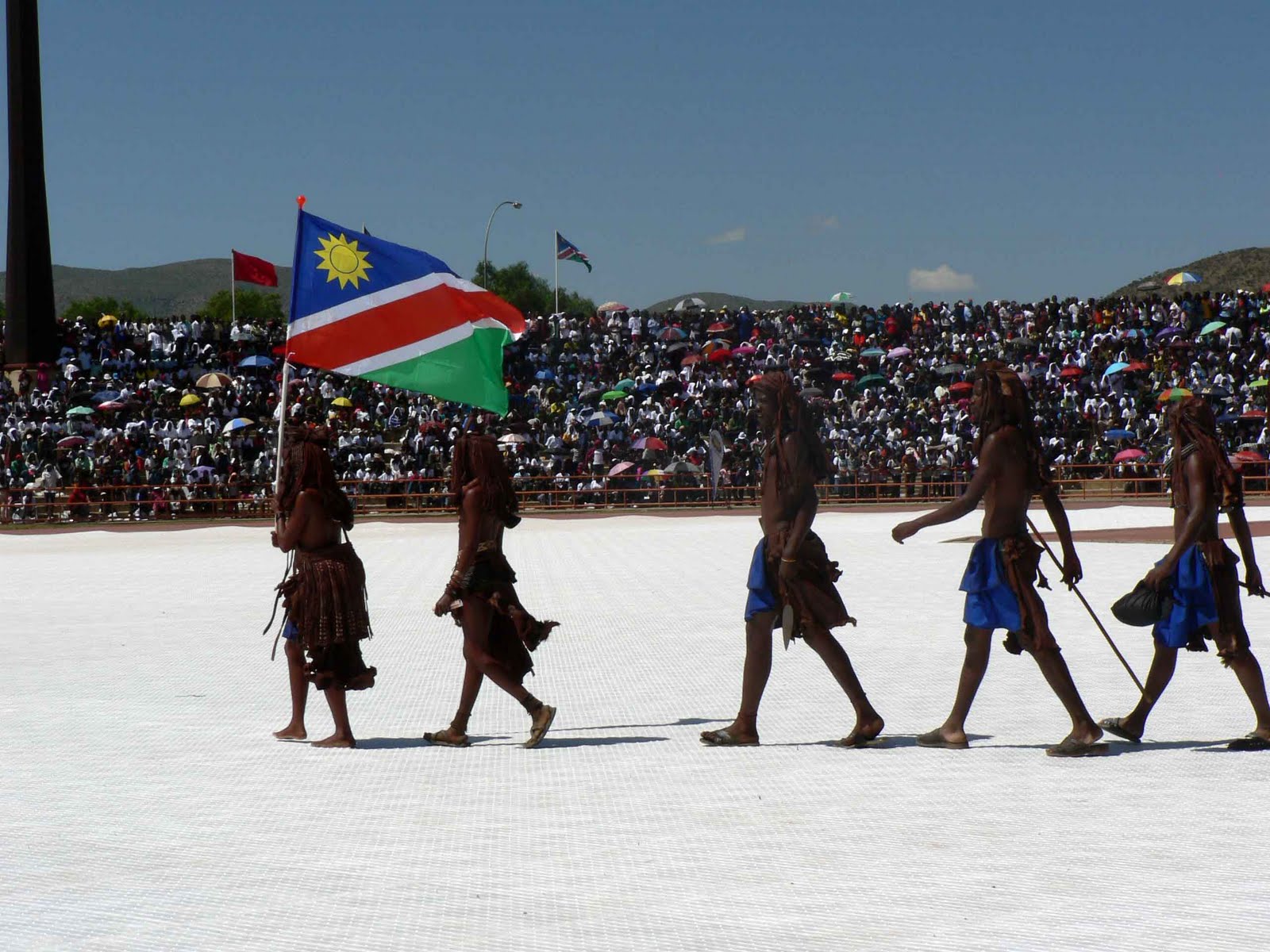
During the weekend, I had my first dance-club experience in Windhoek, which was freeing. I attended my first international football/soccer match, which resulted in a 0-0 draw, but was fun anyway. I got pelted with candies and smiles at a parade down Independence Avenue. I went to a gospel concert where I learned new dance moves (watch out Kirk Franklin). And I saw constant images of the many types of people and customs that classify Namibia as contrasting and beautiful.
Current and former Heads of State and other dignitaries from Zimbabwe, Angola, South Africa, Malawi, China, and Cuba, among other supportive countries, came to Windhoek to witness and participate in formal festivities, especially the day-long celebrations at Independence Stadium. Ah, Independence Stadium. That was an experience.
While the VIP gates, processes, and controls at the stadium were fairly well identified, open, and managed by uniformed officers, the other nine(9) entrances for the general public were jammed, closed, unmanned, and daunting for most of the morning. I, along with two friends, waited in one of these lines with the hundreds of others for about 2 hours, with each of us taking turns checking out other lines and trying to decipher the organizer’s system or plan. Still confused, we finally decided that we would leave the line - it hadn’t moved in the whole two(2) hours we were in it – and either wait in a more direct, shorter line (that also led to locked, unguarded gates) or move to another venue altogether. After watching the chaos of new busloads of would-be spectators arriving, laughing at the impatient (and naughty) children hurling their bodies over the walls of the stadium, and figuring that entry before the end of the morning’s events was slim to none, we continued walking around, scouting out the location of the afternoon’s football game between Namibia and Botswana.
And then, like I blessing, came Moses. I was so glad to see that blinding green suit; it would be our actual ticket in. Convinced that “money talks,” I now know that a fly green suit does the same trick, which is probably safer in the midst of anti-corruption commissions. But, it wasn’t an easy ticket.
Who’s Moses? you ask. Well, Moses “Black Door” Shilongo is a local performing artist, who also happens to be the ever-present husband of the WorldTeach Namibia Field Director, and as such, part of WorldTeach Volunteers’ social network/family in-country. I always have random “Moses sightings” when roaming the streets of Windhoek, but this was an especially welcomed encounter. Black Door, Moses’ stage name, was scheduled to perform IN the stadium, so we promptly each grabbed one of his items (his RED suit, equipment bag, box of CDs) and became his (un)official entourage. Little did we know, at the time, that he was having trouble gaining entry as well. A classic and common retort we received from the uniformed Namibian officers at the various gates to which he was sent was that, “We are not working on ‘African Time’ anymore. Why are you late?” Further, the officers were not a part of the organizing committee and the majority of them basically had no idea where to send the entertainers or any permission (or desire) to abandon their post to help us actually get answers.
After about 90 more minutes of shuffling around from gate to gate with the other entertainers also stuck outside, we finally made it to the big stage and took our places in the open arena, with impressive vantages of the crowd, room to breathe, and perfect positioning for pictures of performers. Thank goodness, because the Himba performers, bodies covered in their traditional red ochre, were getting way too close to Black Door, having actually rubbed against his vulnerable bright green suit, causing even more frustration for the artist who was ready to about-face home.
Yes, we’d missed the parade, the arrival of dignitaries, the formal swearing-in of the president, the announcement of the new cabinet, and the distribution of the lunch bags; but, we were able to hear some of the presidential address and participate in some of the closing morning formalities (Anthems of Namibia and the African Union). Without Black Door, we would not have gotten in before all the dignitaries left, we would have been crunched into the stands when we did get in, and I would not have gotten the cool experiences and pictures afforded me through the eyes of the performers of the day. Good Times. Happy Independence, Namibia!. And Thank Moses.
Thursday, March 11, 2010
Start Spreading the News

I just received and accepted an offer of admission to resume doctoral studies at Teachers College Columbia University in the fall. This time, I will be pursuing a doctorate of education (EdD), rather than a doctor of philosophy (PhD). Over the past years, I have come to understand the difference in the two degrees. While the PhD is primarily geared at nurturing academics for university teaching roles, the EdD is more geared towards equipping senior-level practitioners and executives with the tools of applied research. I will be a student in the department of International and Transcultural Studies, in the programs in Comparative and International Education Development, with a concentration in International Education Policy Studies.
Start sending the money, should be the actual title of this post. It should be an interesting transition after three years of no real salary to suddenly have a US$60,000 bill (the approximate total of annual tuition and fees). It is definitely time to begin hunting for work and fellowships. I’m pretty sure that I have secured housing, so I won’t need to deal with that.
In any event, I am excited to have my next journey semi-mapped out. I was a mere 22 years of age when I began the PhD program at TC. I was focused, ambitious, engaged, bright, and somewhat accomplished (for a first-generation college graduate from the inner-city); however, I lacked exposure to truly place the degree and my future in the most appropriate and satisfying context. At that time, I made the difficult decision and voluntarily left the program, but at least with a master of arts in hand. I always knew I would return to the higher degree and I have never stopped enjoying applied research. With the travels and work I have embraced over the past nearly 15 years, I am now ready to resume doctoral-level study and the Comparative and International Educational Development programs appear to be the good fit.
I Need Help
“Ha---Rold! Sit Down!”
“Yes, ‘more than’ means ‘bigger.’ “
“No, the computer room is full. Sessions will begin at the end of March. Today is just for testing these learners.”
“Whoa, Panduleni! Check your work. Is that really the correct answer?”
“Ha---Rold! Sit Down!”
“Who turned their computer off?!? Chanique! What did I say about touching that button?”
“Yes, Ronaldino? You may go to the toilet.”
“This is called a mouse. Hold it like this. No, like this. Relax your hand and fingers. Good.”
“Who called me?”
“Ha---Rold! Sit Down!”
“No, you may not enter today. The computer room is full. We are just testing these learners. We will officially re-open at the end of March.”
“Yes, I see, Marchelle. You entered the right answer. Great job. Now, click the forward arrow for the next question.”
“A penny is a coin we use in the United States. Those are pennies in the box. How many pennies do you see? Een? Twee? Drie? Vier? Vyf? Baie.”
“Theresa, did you say you can’t open your account? Okay. Let’s see if we can find the problem. One minute.”
“Ha---Rold! Sit Down! If I have to say that one more time…..”
That afternoon was pure energy. I had about 40 learners show up for a session that was designated for 25 pre-selected learners (the maximum the Centre could hold). The goal was to administer a mathematics assessment and expose a few learners to the Centre’s resources and rules before it fully re-opens. So, after admitting the originally-selected twenty-five, I had to deal with the other 15 who simply would not leave the front door. I should be happy that the interest is high, but it was truly exhausting.
Within the class of 25, I had another three sub-groups.
1. Those learners who never touched a computer before and needed basic orientation
2. Those learners who never used the PLATO software and needed guidance on how to log-in and navigate within the system
3. Those learners who spent much of the past year in the Centre, apparently doing whatever in the world they pleased. (they were the most unfocused and disruptive of the bunch).
So with the four populations of learners, all primary school age I might add, in extended testing mode, often wanting affirmation and to share praise received from the computer, and without fully functioning air-conditioning units, and as the only adult in the room, I had my hands completely full. Yes, I needed and still need help. All super-puns included, and you can let it mean what you like.
The experience, as always, though, was instructive. I had not had such a draining time with any group of learners in my former Centre in Khorixas. I also had already conducted the same exercise with 75 other learners from seven other Keetmanshoop schools, without this resultant admitted sense of chaos. I guess it was time I got a sense of the classroom management problems that other volunteers had mentioned often. It was also good to see the challenges that would face those who would assume leadership hopefully before and definitely after my departure here in Keetmanshoop.
I already have signs on the doors explaining the current activities of the Centre and the fact that the Centre will not re-open until the end of March. I immediately began drafting a flyer for grade 12 learners to apply to become Volunteer Centre Captains; they can help manage crowds outside and answer basic questions inside. I also immediately began creating big posters with the Centre Rules. Finally, I drafted a request for teachers to shadow me in the Centre as Senior Teacher Ambassadors. I already have a group of teachers from each of the nine schools to serve as “regular” Teacher Ambassadors,” for the purposes of planning and general advocacy, but I needed them to step up their game. The lure for these “Senior” ambassadors was a t-shirt (I picked up a few during my business trip to meet the software account personnel in Johannesburg in November), and a certificate (which I would make look so nice and official that framing would be likely).
I will see how many assistants my efforts have yielded by Friday, 12 March. Until then, grant me the strength. Or at least help me learn how to say all of the phrases above in both Afrikaans and Nama/Khoekhoegowab.
.jpg)