I suppose that nothing in life comes free. I utilized frequent flyer miles to get back to Namibia this month and my experience was yet another adventure for the blog and for future gasp-inducing tale-sharing. My flights were all classified as “Reward Travel,” but I found many of the “rewards” questionable.
I spent a total of 32 hours in the air and an additional 12+ hours in five different airports over my three day “Reward Travel” journey back to Namibia. I left Los Angeles International Airport on the morning of Tuesday, 5 January and arrived at Hosea Kutako International Airport in Windoek, Namibia on the evening of Thursday, 7 January.
Ten(10) Lessons I Learned
1. Do everything you can to NOT have a center or middle seat during such a long flight. Call the airline each day and beg if you think it will help your case.
2. Use (your mother’s) additional miles to get BUSINESS CLASS accommodations when the trip is this long. The benefits on the plane make the flights bearable and the benefits extend to the airports, cushioning the wait time between flights.
3. Singapore Changi Airport is the bomb! FREE mints, FREE movie theaters, FREE game zones, FREE internet, rooftop swimming pool, (butterfly, orchid, cactus) gardens and clean areas for relaxation(including FREE chair massages), FREE city shuttle and arranged tours (though my wait was not long enough to take it), and more.
4. Ask a flight attendance to tell you the actual contents of the Japanese appetizer mixer bowl served with the in-flight lunch plate BEFORE you ingest it all.
5. Always keep airsick bags in your purse (probably related to lesson #4 above)
6. Each time the drink cart passes, request boxed juices, even if you are not thirsty, to build a ready arsenal to “unparch” yourself when you finally wake up, the lights are off, everyone is sleeping, and you don’t want to risk annoying the mess out of all the other passengers (and stewards) with call-buttons, lights, and conversations (although the unparching can lead to a potty trip, which will wake everyone up anyway).
7. The "succulent sandwiches" on the light meals menu for Singapore Airlines are actually quite succulent, namely the curry chicken and the tuna. Two thumbs up for fresh potato bread!
8. Two mini-pints of Ben & Jerry’s Cherry Garcia may not be the best closer to the four-course, in-flight, Japanese dinner, with the mystery seafoods.
9. Singapore Airlines serves ice cream! (cautions noted in lesson #8 above)
10. Try to smile and take cheap comfort in the fact that the year is not 1510 and your intercontinental, overseas travel is not available solely by donkey(land) and boat(sea).
Nevertheless, when I reached Windhoek, Namibia, I stayed in my hotel and slept for the good majority of three straight days, only rising to tend to my most basic needs. I had another 4.5-hour drive to reach my house in Khorixas, Namibia on day four….It will take a while to get back into a regular sleep-wake-work schedule.

Wednesday, January 13, 2010


Sunday, December 6, 2009
Our Southern Africa Amazing Race


I guess I should feel bad, well worse (because I already feel physically spent), for putting my 62-year young dad through Southern Africa Adventuring 101, but it was all good. He asked for some of it, though unknowingly. I think I can say that I undertook my three most physically challenging feats of the year all within the past two months. They were all exhilarating and fun; however, I am cool saying, “Been there, Done that” for each activity and am content to never do any of them again.
Task 1: Quad Bike Safari – Advanced Trail
When the chubby quad bike guide, flanked by his 10-year old grandson who would be joining us, “warned” that we may want to take an “easier” trail, my dad and I were both quick to opt for the “advanced” trail, statedly confident that if They could do it, We could do it. We soon learned that we were indeed in for a challenge. From the heights we scaled and the drops off the slithers of mountain they carved for the experience, to the 40+ degree inclines and declines we had to maneuver, the heat was on. I was a bit anxious for it all to end about half-way through the trip. As the guide pointed to game and wildlife to the left and right, I completely ignored him to stay focused on my path and technique. Dad did pretty good, though based on my limited understanding of the laws of physics, I was scared at least a few times that he might flip backwards when trying to manage the inclines.
Task 1: Quad Bike Safari – Advanced Trail
When the chubby quad bike guide, flanked by his 10-year old grandson who would be joining us, “warned” that we may want to take an “easier” trail, my dad and I were both quick to opt for the “advanced” trail, statedly confident that if They could do it, We could do it. We soon learned that we were indeed in for a challenge. From the heights we scaled and the drops off the slithers of mountain they carved for the experience, to the 40+ degree inclines and declines we had to maneuver, the heat was on. I was a bit anxious for it all to end about half-way through the trip. As the guide pointed to game and wildlife to the left and right, I completely ignored him to stay focused on my path and technique. Dad did pretty good, though based on my limited understanding of the laws of physics, I was scared at least a few times that he might flip backwards when trying to manage the inclines.
Task 2: Dune Climbing
Although I hear that there are many more wicked ways to conquer the beautiful and famously-high sand dunes of Namibia (i.e. sand surfing), the basic walks up and down were enough for me. At one point, I simply chose to “de-shoe” because the pressure of the filling sands on my toes was too painful. Luckily, we had an early morning start so my feet didn’t burn along the way. I think it was pretty intimidating. Aside from the fact that walking in the sand is taxing, we were easily more than 300 feet off the ground….with an even more dune height to conquer!! You could look left and look right and see just how high you were. Plus, the shifting sands made you feel even less comforted. Topping it off, our plan was to “run” down the side of the dune to get back to the valley floor. Even though individuals looking to be much older than my father walked around me at a few points on the dunes’ vertices, I bailed down the side of “Big Daddy Dune” (real slowly, doing the near opposite of anything that might be called a “run”) before others, including my father, in the group.
Task 3: Table Mountain’s Platteklip Gorge
Ah, Table Mountain. The muscles in my thighs and calves are still tight and sore from this mountainous task (super-pun intended). Table Mountain is a sight to behold and the views all around its plateau were breath-taking. We took a cable car up to the top and decided to walk down, after finishing a guided tour of the flora, fauna, and historical features of this part of a World Heritage Site. The interaction with the other hundreds of Table Mountain visitors was comforting. We met people from all over the world up there. Admittedly, we were often initiating conversation as stall tactics in order to catch our breath and reflect on what we thought we were doing by not buying a return ticket on the cable car. The people we met along our hike down were so confident, though, that they actually inspired us to keep it up. Children were running up and down, as my dad and I struggled from rock to rock. One man was carrying his son on his shoulders, while another one-legged man was beginning the journey UP when we finally made it to the bottom (a feat that took us almost FOUR HOURS!). About three teams of everyday people posing as hikers passed us on their way up and came back down and passed us again during our slow journey. I was NOT in any hurry, but if I could blame our pace on something, I’d blame it on my (too) close-fitting shoes. It was hard to get the right traction and confidently climb from rock to rock because my toes would painfully press into the tip of my shoe each time I took a strong downward step. Whatever. Like I said, been there, done that, check-off that box.
I need to say in closing this post that I am not a wimp (and probably not alone). The tasks I completed with my dad were challenging and I’d probably do it all again if loved ones were interested. For now, though, I need to chill because it will take my body a few days to recover from my most recent adventure, the Table Mountain thrill. When I return to work, I am inspired to exercise more, create and adopt a more healthy diet, and pay attention to my vitamin intake. We’ll see what happens.
Look out for a full itinerary and reflection from my dad’s visit/trip after he leaves in a few weeks.
Wednesday, November 11, 2009
Viewer Discretion Advised


I guess I spoke to soon in my Rhinosinusitis post, both about the recovery process and about Namibia’s “free” health care. On Wednesday morning, I woke up pain-free but looking like a character on Planet of the Apes, or maybe like a child looking into a funny mirror at the carnival. Whatever the agreement is on my resemblance, I was certain that I needed more doctor’s advice about my condition. My doctor recommended I head to the city of Windhoek to see an ear, nose, and throat specialist. He suggested I get a facial scan.
I immediately started sending texts and before long, I had a ride in a government vehicle to the city. Rides, though, don’t come trouble-free. I wasted a good 3-4 hours going here and there with my driver before actually arriving at Windhoek Medi-Clinic, the hospital my friend told me to visit. The private hospital I visited was a clear departure from the meager public facility in my little town of Khorixas. Luxury vehicles laced the parking lot and the environment was pristine; customer service was also quite nice. My visit cost me N$491 (about US$60) a far cry from the N$4 (about US$0.75) I spent in Khorixas.
On Thursday morning, I visited an ear, nose, and throat specialist at Roman Catholic Hospital, another private facility. The specialist inspected me and ruled out a few more serious conditions that surfaced as possibilities in the minds of the first two general practitioners I visited. He suggested I remain on my current treatment and gave me his card for follow-up if I experienced any further problems. Bringing a challenged smile to my face, he treated me pro-bono.
It honestly did not take very long for the swelling to go down. Each day, I resembled something that looked more and more like the “normal” me. The first picture in this post was taken on Wednesday morning. The second picture was taken on Friday.
The trip may have been a little blessing in disguise. In my absence from the Khorixas Centre, my colleague finally stepped up to the administration plate and independently managed an assignment we planned to do together. Also, I was able to push forward a few stagnated action items on the desks of individuals in my supervising Ministry of Education office in Windhoek. Finally, I chilled! My friend from Khorixas had a conference near Windhoek over the weekend. Her event was held at the 20,000 hectare (whatever that means) Heja Game Lodge, which is in between the airport and the city, and which has plenty to keep the mind mellow. I watched springbok, wildebeasts, warthog, egrets, ostrich, and many more indigenous species of animal roam free as I relaxed all day on a hammock by the pool. I actually may have chilled too hard. The result of my excess, unprotected sun-bathing is now a peeling nose. Next time, sun-block and a hat.
Came Sunday, I had a ride home and an easy feeling. I needed that. (Let’s hope my medical insurance reimburses me for my hospital visit. It wasn’t a lot of my money, but I need that too).
Tuesday, November 3, 2009
Rhinosinusitis
The title of this post kinda sounds like a prehistoric animal, but alas, it is my health diagnosis. Over the weekend, I noticed a little puffiness in my left nostril. Last night(Monday), it flared and the pain was excruciating, even into my teeth! I decided to take the long, hot stroll to the hospital, which was an experience.
The Khorixas Hospital is broken into two main parts for patients. One part is a clinic where your vitals are taken by nurses and where it is determined if you should be seen a doctor. The other part is the main wing where you wait and see a doctor and where you fill any prescriptions you may be given.
The clinic was packed and I felt like I was at times getting worse because of the presumed loose bacteria and airborne illnesses probably all around me. Other times, I felt like I was getting better because of how mild I seemed to look in comparison to others. The pain was no joke, though, so I stayed around and hoped I didn’t leave with more problems than I had prior to the visit. I also hoped that someone would accurately diagnose me and help me quickly get out of my misery.
Luckily, I am good friends with two of the doctors and one head nurse, so I knew I would see familiar faces. The two doctors are from Nigeria and spent a lot of time hanging out at our house, prior to their wives relocating here from their home country. The head nurse is from Zimbabwe, as is my closest friend in Khorixas, and often visits her at her house; we were together at a little house party last month. Still, I did not want to see them in their element, where I was a patient and in desperate need of their care. I was a bit nervous actually, which I am not sure is cool to admit.
I can also honestly say that even after being here for nearly a year, I still haven’t tried to convert the various measurements into the units I actually understand. So, I am just assuming that my temperature of 36 degrees was fine. I also don’t know what my weight of 58.8 kilograms means in pounds. I think I’ll do the lesson on conversions when I get back to work.
I spent at least two hours at the hospital and the examination was not as bad/painful as I imagined it would be. The doctor diagnosed me with Rhinosinusitis, and prescribed me with the antibiotic, Amoxicillin; the pain killer, Ibuprofen; and a nasal spray to reduce the swelling. The whole visit, including the consultation and drugs, cost me U.S. $0.75 (yes, that’s seventy-five cents, or four Namibian dollars). Imagine that. I guess that is what free and accessible health care truly means.
I obviously feel much better; I actually wrote and posted this entry. Last night was another story; I was miserable. The pain killer is working, thank goodness; although, the area around my left nostril in still swollen. Let’s hope the recovery remains steady and that I won’t be making any more trips to the hospital, except to say, “Hello” to friends.
The Khorixas Hospital is broken into two main parts for patients. One part is a clinic where your vitals are taken by nurses and where it is determined if you should be seen a doctor. The other part is the main wing where you wait and see a doctor and where you fill any prescriptions you may be given.
The clinic was packed and I felt like I was at times getting worse because of the presumed loose bacteria and airborne illnesses probably all around me. Other times, I felt like I was getting better because of how mild I seemed to look in comparison to others. The pain was no joke, though, so I stayed around and hoped I didn’t leave with more problems than I had prior to the visit. I also hoped that someone would accurately diagnose me and help me quickly get out of my misery.
Luckily, I am good friends with two of the doctors and one head nurse, so I knew I would see familiar faces. The two doctors are from Nigeria and spent a lot of time hanging out at our house, prior to their wives relocating here from their home country. The head nurse is from Zimbabwe, as is my closest friend in Khorixas, and often visits her at her house; we were together at a little house party last month. Still, I did not want to see them in their element, where I was a patient and in desperate need of their care. I was a bit nervous actually, which I am not sure is cool to admit.
I can also honestly say that even after being here for nearly a year, I still haven’t tried to convert the various measurements into the units I actually understand. So, I am just assuming that my temperature of 36 degrees was fine. I also don’t know what my weight of 58.8 kilograms means in pounds. I think I’ll do the lesson on conversions when I get back to work.
I spent at least two hours at the hospital and the examination was not as bad/painful as I imagined it would be. The doctor diagnosed me with Rhinosinusitis, and prescribed me with the antibiotic, Amoxicillin; the pain killer, Ibuprofen; and a nasal spray to reduce the swelling. The whole visit, including the consultation and drugs, cost me U.S. $0.75 (yes, that’s seventy-five cents, or four Namibian dollars). Imagine that. I guess that is what free and accessible health care truly means.
I obviously feel much better; I actually wrote and posted this entry. Last night was another story; I was miserable. The pain killer is working, thank goodness; although, the area around my left nostril in still swollen. Let’s hope the recovery remains steady and that I won’t be making any more trips to the hospital, except to say, “Hello” to friends.
Saturday, October 31, 2009
Back to Ghana


Although this post is entitled “Back to Ghana,” it really talks about my first trip to the nation. It has been over two months since the experience, however, and I am only now getting “back” to publishing a few details about it.
In July, a good friend decided that he would celebrate his 40th birthday in Ghana and invited me to join him on the trip. He didn’t have to ask twice. The big day was August 16 (although I didn’t arrive until August 17). Lucky for him, this was not his first trip; he suffered from acute poisoning after a steak dinner on day two, which seriously impacted his ability to get out and about.
In July, a good friend decided that he would celebrate his 40th birthday in Ghana and invited me to join him on the trip. He didn’t have to ask twice. The big day was August 16 (although I didn’t arrive until August 17). Lucky for him, this was not his first trip; he suffered from acute poisoning after a steak dinner on day two, which seriously impacted his ability to get out and about.
I must say that the plane ride was the BOMB. I traveled using frequent flyer miles and fortunately, I had no option about whether to travel economy or business class, because only business class was available. It is very easy to get spoiled by the right type of business class. The seats were wide and comfy, fully reclined into horizontal position, and were just heavenly…….. Ahhhhhhh…….But enough about the plane.
This post is about my sojourn to a West African nation filled with history and lore. Ghana is the birthplace of Kente cloth, one symbol of African identity, pride, and honour embraced by masses of African-Americans; it is the home of ancient Kingdoms and Empires; it is a nation where millions of blacks were sold into slavery and transported to the United States and other former slave-holding countries; and among other historical markers, it is the first sub-Saharan African country to gain independence from European colonial powers.
Highlights
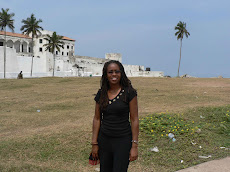
It seems impossible to visit Ghana without exploring places that played critical roles in the transatlantic slave trade. According to one tour guide, over half of the European-owned coastal forts and castles discovered along West Africa are located in Ghana. I visited a few former trading posts and the experiences were very moving. The “Door of No Return” was eerie at both Elmina Castle and Cape Coast Castle. It was through these doors that millions of chained men and women left Africa, boarded ships, and never saw their freedom, family, homelands, and some of their various cultural traditions again. Another feature of each castle that left visitors caught in thought were the churches and chapels where captors and traders worshipped, seemingly without regard for the inhumanity of their subjugation practices. I also found it interesting that one former trading castle in Accra now serves as the Presidential Palace.
It seems impossible to visit Ghana without exploring places that played critical roles in the transatlantic slave trade. According to one tour guide, over half of the European-owned coastal forts and castles discovered along West Africa are located in Ghana. I visited a few former trading posts and the experiences were very moving. The “Door of No Return” was eerie at both Elmina Castle and Cape Coast Castle. It was through these doors that millions of chained men and women left Africa, boarded ships, and never saw their freedom, family, homelands, and some of their various cultural traditions again. Another feature of each castle that left visitors caught in thought were the churches and chapels where captors and traders worshipped, seemingly without regard for the inhumanity of their subjugation practices. I also found it interesting that one former trading castle in Accra now serves as the Presidential Palace.
I will not soon forget the TRAFFIC in Accra. It was seriously no joke. Luckily, there were things to do while waiting for the congestion to clear. If you were in the mood to shop, you could buy just about anything you needed right from your car window. Street hawkers took vending to the next level. Candy, drinks, fruit, vegetables, clothes, toiletries, jewelry, houseware, toys, pets/puppies, you name it, a street vendor had it. I was amazed that (1) I did not see anyone get hit by a car during their weaves in and out of traffic to make a sale, and (2) I did not see many product-casualties – vendors carried most products on their heads!
Another etched memory is the endless homage to President Barack Obama and First Lady Michelle Obama. The Obama’s visited Ghana about one month prior to our trip. There were billboards everywhere welcoming the president and couple, and declaring a “new day,” promising future of change, and partnership between Obama and the Ghanaian President.
It was a definitely unique and memorable trip. There is so much to share about the sights, sounds, and discoveries in Ghana, I'll have to do it in pieces and in person.
Here was my itinerary:
Day 1: Arrive at Kotoka International Airport
Day 2: Accra Mall; Internet Café; Dinner at a rooftop restaurant in Accra
Day 3: Nima Market; Ghana School of Law; Supreme Court; Kwame Nkrumah Museum and Memorial Park; Greater Accra Centre for National Culture; Evening trip to Lister Hospital (not for fun)
Day 4: General touring and shopping around town; Jonathan’s speaking engagement at University of Ghana – Legon
Day 5: Shopping around Town; Dinner and Movie at Accra Mall
Day 6: Taxi to Akosombo Dam and Dodi Princess Cruise on Lake Volta (largest man-made lake) –Dancing!!; Evening concert at Alliance Francaise Accra– More Dancing!!
Day 7: Jonathan’s return flight to the U.S.
Day 8: Connect with One Africa Guest House owner at the W.E.B DuBois Memorial Centre for Pan-African Culture; Drive to Elmina
Day 9: Canopy Walk in Kakum National Park; Tours of Elmina Castle and Cape Coast Castle
Day 10: Early Morning bus from Elmina to Accra; Evening flight from Accra to Johannesburg
Day 1: Arrive at Kotoka International Airport
Day 2: Accra Mall; Internet Café; Dinner at a rooftop restaurant in Accra
Day 3: Nima Market; Ghana School of Law; Supreme Court; Kwame Nkrumah Museum and Memorial Park; Greater Accra Centre for National Culture; Evening trip to Lister Hospital (not for fun)
Day 4: General touring and shopping around town; Jonathan’s speaking engagement at University of Ghana – Legon
Day 5: Shopping around Town; Dinner and Movie at Accra Mall
Day 6: Taxi to Akosombo Dam and Dodi Princess Cruise on Lake Volta (largest man-made lake) –Dancing!!; Evening concert at Alliance Francaise Accra– More Dancing!!
Day 7: Jonathan’s return flight to the U.S.
Day 8: Connect with One Africa Guest House owner at the W.E.B DuBois Memorial Centre for Pan-African Culture; Drive to Elmina
Day 9: Canopy Walk in Kakum National Park; Tours of Elmina Castle and Cape Coast Castle
Day 10: Early Morning bus from Elmina to Accra; Evening flight from Accra to Johannesburg
Photos included in this post: Me in front of the tomb of Kwame Nkrumah's (Ghana's first President); a plaquard celebrating the 50th anniversary of Ghana's independence from England; a vendor selling jewelry at Nima Market; and a highway billboard reading "Akwaaba (Welcome) President Obama"
Saturday, October 17, 2009
My Third Trimester

No, I am not with child. I am, though, into my third trimester of interaction with hundreds of schoolchildren in Northwest Namibia.
Schools throughout the country operate in three terms per year. The third and final trimester of 2009 began in early September and will end, for most, at the beginning of December. It will end sooner for grade 10 and grade 12 learners.
There is an increasing expectation and push for teachers in public schools around the country to complete their syllabi in the first two terms, so that the third term can be spent helping learners review and prepare for final exams. Learners in grades 7, 10, and 12 must take national standardized exams in the third term. Grade 10 exams are over at the end of October, after which time they are free for the remainder of the year. Grade 12 exams continue into November.
The standardized exams for grades 10 and 12 are critical. In the case of grade 10, learners who do not receive enough passing marks will not be allowed to move to grade 11. In the case of grade 12, learners who do not receive the required scores will not graduate. In both exam situations, learners failing to earn the required passing marks are not allowed to return to school the following year. They must:
- prepare to retake the exams either through independent study or an approved program designed to assist learners who have failed (They may return to school once they have passed the required tests);
- enter a vocational school or program;
- enter the workforce; or
- choose some other life path available to individuals without secondary school certificates.
Unfortunately, a few of these learners (without secondary school certificates) end up teaching in Namibia’s underresourced public schools, earning full credentials along the way. You can imagine the challege this can present in the classroom.
Over the past year, I have learned that because of the past inequities in the educational system and a still developing teacher-training system, many teachers are not fully knowledgeable about the academic subjects they have been hired to teach, especially in the math and science disciplines. Some teach straight from textbooks and tend to stick to a single method of introducing new topics to learners. I have now begun encouraging teachers to utilize the Centre to improve their subject understanding and possibly adopt different instructional techniques. Language barriers, confusion about the role and offerings of the Centre, and trepidation about using computers are still three of the biggest obstacles to greater teacher engagement in the Centre.
Throughout this trimester, I have been focused on drafting an operations manual for the Centre, including a comprehensive Centre Manager job description and planning calendar; gathering input on registration and learner selection policies; continuing to train and motivate teachers and administrators to take ownership over the Centre; collecting and analyzing school, class, learner, and Centre performance data to begin evaluating potential impact; and familiarizing myself with the scope and tools of the educational learning software. I’ve been super-busy and super-pumped, and yes, my colleague (supposed counterpart) at the Centre still finds time to read books and magazines during the workday. Pity.
Although my original contract ends in December, I have decided to commit another six months to this project. There is just so much potential and so much work to be done.
At the end of this trimester, I will relocate to the capital city of Windhoek and work as an advisor for related computer-based learning centres throughout the country. I will also spend time working in the southern town of Keetmanshoop to review and hopefully revitalize the math and science centre there.
Things Fall Apart
The past week was emotionally difficult. On Monday, October 12, a fellow volunteer in a nearby town died unexpectedly in his sleep.
The volunteer was a member of Nigeria’s Technical Aid Corps(TAC), the international volunteer program for Nigerian professionals. My housemate is also a TAC member and was very close to Folorunso, the deceased. Folorunso was a frequent houseguest and the news of his passing was a serious shock.
It truly highlights the fragility of life. It also draws attention to the sacrifices we make and risks we take as volunteers in a foreign country. We especially risk not being around family and friends during times of triumph, or in this case, tribulation. I have missed four births of family and friends back home, for example, since I journeyed to Namibia.
The sacrifices and risks seem worthwhile when observing the direct benefits of our service. When you see a few of the fruits of your labor, you truly want to live life to the fullest and make impacts where you know you can. When tragedy strikes, however, the shock can cause the mind and soul to wonder, “Why?" and "Why am I here?”
I must admit that I was hyper-sensitive to everyone’s direct and indirect interaction with me throughout the week. There were fleeting, though unfounded, feelings of being under-appreciated at times. I became annoyed when I didn’t receive returned phone calls, or e-mail and text messages from colleagues. I was constantly annoyed while walking to and from work, frustrated at the government’s lack of foresight and determination in arranging readily accessible car transport for my project. And I remained annoyed with the perceived lack of passion and dedication in my colleague who may be assuming leadership over the Centre once I am gone. Without a solid succession plan with qualified personnel, would my investment be a waste? The week was draining.
The week was also extremely productive. I hosted four life science and physical science classes at the Centre, each group showing excitement about seeing topics come to life in front of their eyes and about half using computers for the first time. I had a successful Teacher Development Wednesday, bringing the number of educators participating in my training this term to around 50. On Thursday and Friday, my co-administrator sent a substitute in her place; he was very focused and I enjoyed working with him. And over 100 registered users attended sessions throughout the week, many seeking additional instructional support from me to finally comprehend challenging math concepts. Oh, and I led my second session as a official tutor for University of Namibia students on Tuesday.
I know exactly why I am here. I am comfortable with the decisions I have made. And I know just how quickly life can end. Still, it doesn’t make the loss of a friend less significant.
Folorunso leaves behind in Lagos, Nigeria a wife and five children, ranging in age from about 7yrs to 15yrs. May he rest in peace. And may the family find support and solace in this difficult time and in the future.
The volunteer was a member of Nigeria’s Technical Aid Corps(TAC), the international volunteer program for Nigerian professionals. My housemate is also a TAC member and was very close to Folorunso, the deceased. Folorunso was a frequent houseguest and the news of his passing was a serious shock.
It truly highlights the fragility of life. It also draws attention to the sacrifices we make and risks we take as volunteers in a foreign country. We especially risk not being around family and friends during times of triumph, or in this case, tribulation. I have missed four births of family and friends back home, for example, since I journeyed to Namibia.
The sacrifices and risks seem worthwhile when observing the direct benefits of our service. When you see a few of the fruits of your labor, you truly want to live life to the fullest and make impacts where you know you can. When tragedy strikes, however, the shock can cause the mind and soul to wonder, “Why?" and "Why am I here?”
I must admit that I was hyper-sensitive to everyone’s direct and indirect interaction with me throughout the week. There were fleeting, though unfounded, feelings of being under-appreciated at times. I became annoyed when I didn’t receive returned phone calls, or e-mail and text messages from colleagues. I was constantly annoyed while walking to and from work, frustrated at the government’s lack of foresight and determination in arranging readily accessible car transport for my project. And I remained annoyed with the perceived lack of passion and dedication in my colleague who may be assuming leadership over the Centre once I am gone. Without a solid succession plan with qualified personnel, would my investment be a waste? The week was draining.
The week was also extremely productive. I hosted four life science and physical science classes at the Centre, each group showing excitement about seeing topics come to life in front of their eyes and about half using computers for the first time. I had a successful Teacher Development Wednesday, bringing the number of educators participating in my training this term to around 50. On Thursday and Friday, my co-administrator sent a substitute in her place; he was very focused and I enjoyed working with him. And over 100 registered users attended sessions throughout the week, many seeking additional instructional support from me to finally comprehend challenging math concepts. Oh, and I led my second session as a official tutor for University of Namibia students on Tuesday.
I know exactly why I am here. I am comfortable with the decisions I have made. And I know just how quickly life can end. Still, it doesn’t make the loss of a friend less significant.
Folorunso leaves behind in Lagos, Nigeria a wife and five children, ranging in age from about 7yrs to 15yrs. May he rest in peace. And may the family find support and solace in this difficult time and in the future.
Subscribe to:
Posts (Atom)


.jpg)
